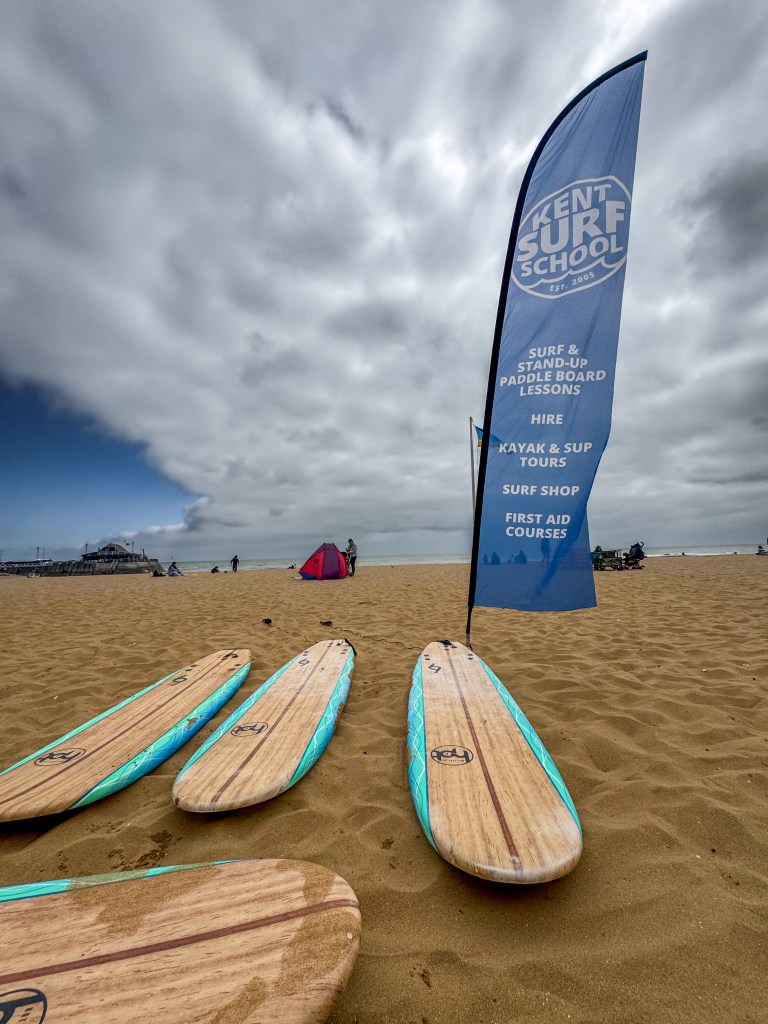
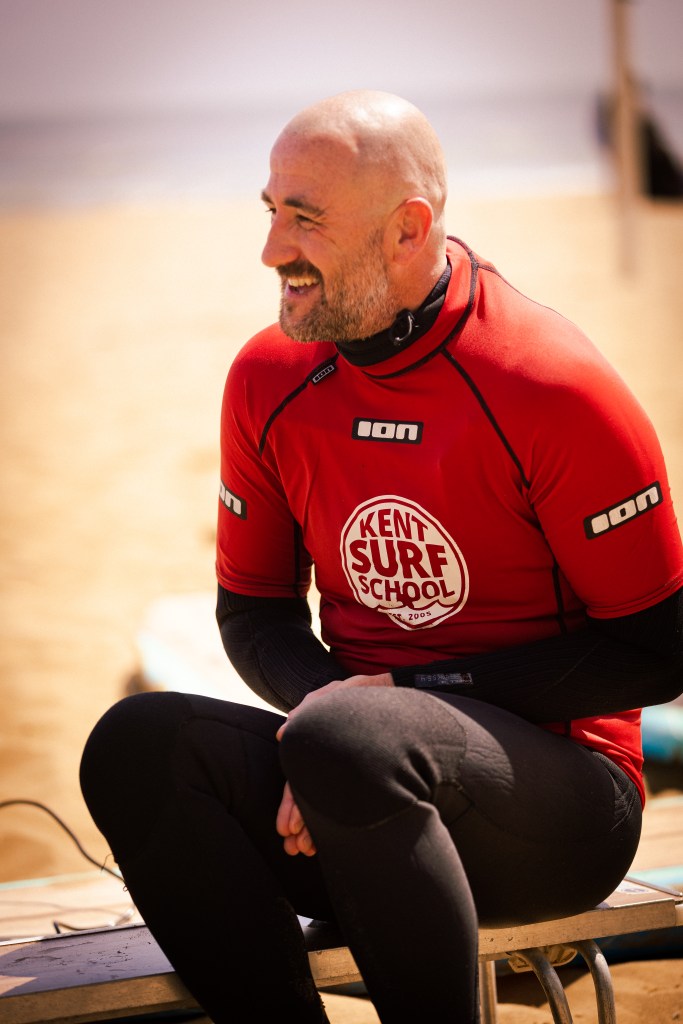
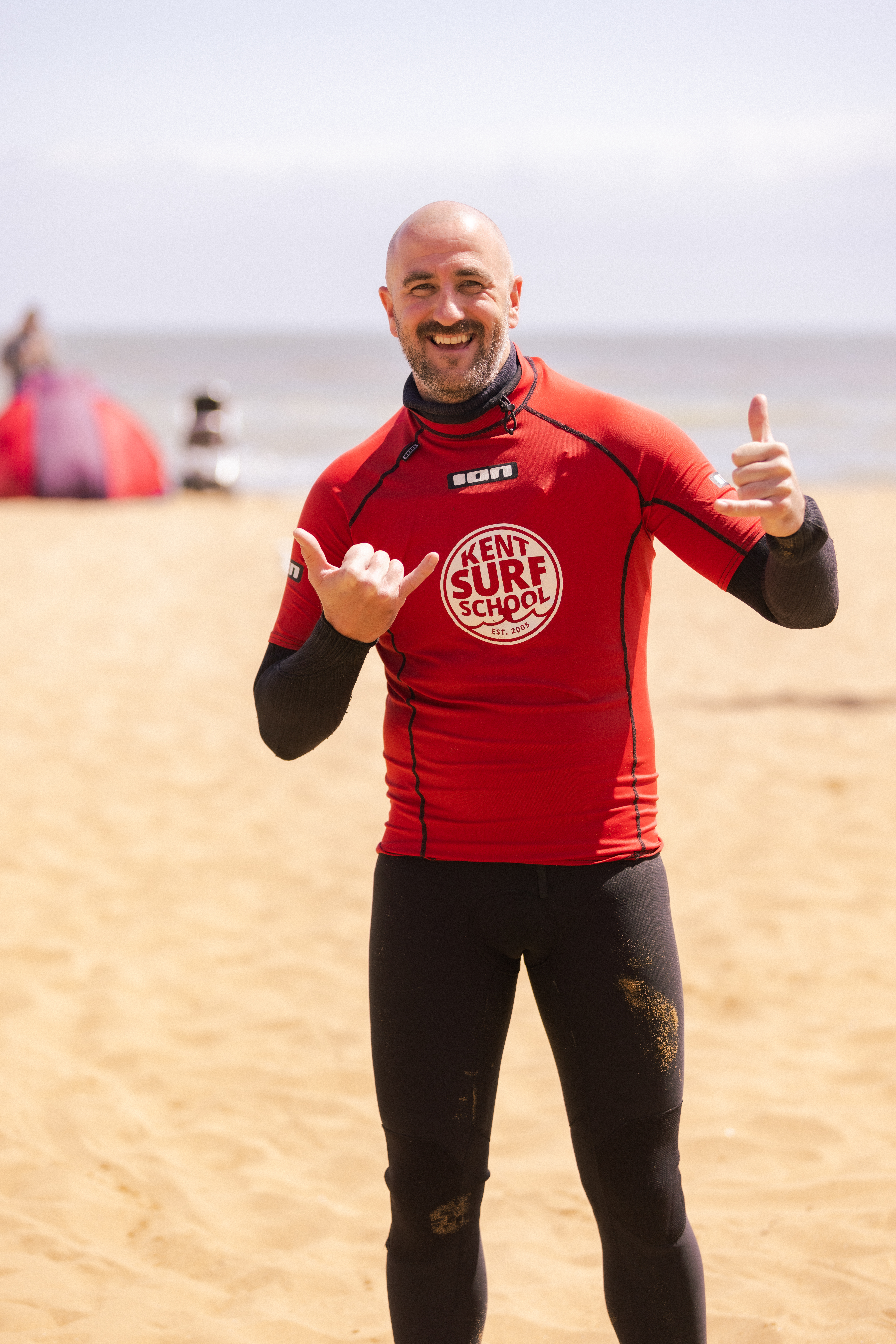
I recently met with Andy Webb, owner of the Kent Surf School. We sat on a bench just outside what Andy calls “his office”, the amazing Viking Bay in Broadstairs, Kent, on a very cloudy Saturday morning. Towards the end of the interview, the wind had blown the clouds away and the sun was shining, the sea was glimmering. We talked about family, doing multiple jobs, passion and community.
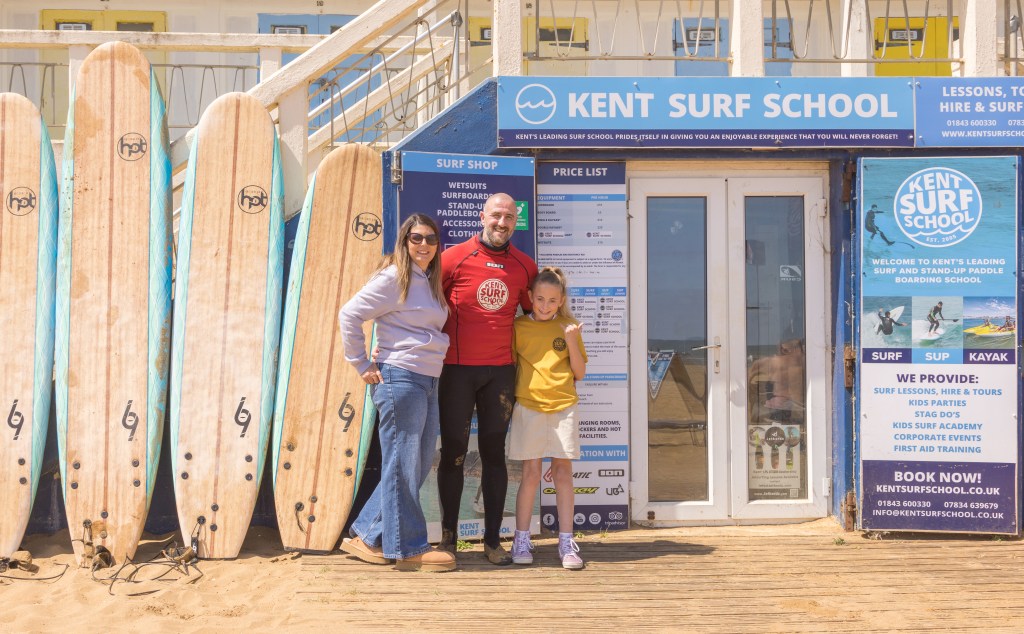
Andy is incredibly down-to-earth, a very modest man with a beautiful wife who supports him and their two lovely girls, Alana (pictured below) and Betsy (11 and 9).
Andy’s journey began with the idea of buying a beach cafe’ when, out of the blue, a friend suggested buying the Surf School which turned out to be a reality for Andy and his family!
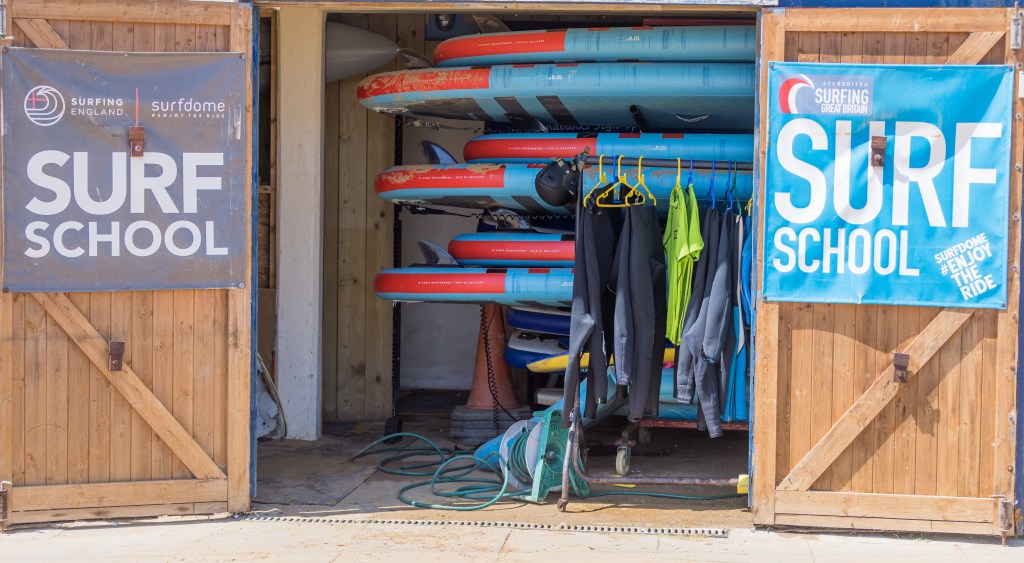
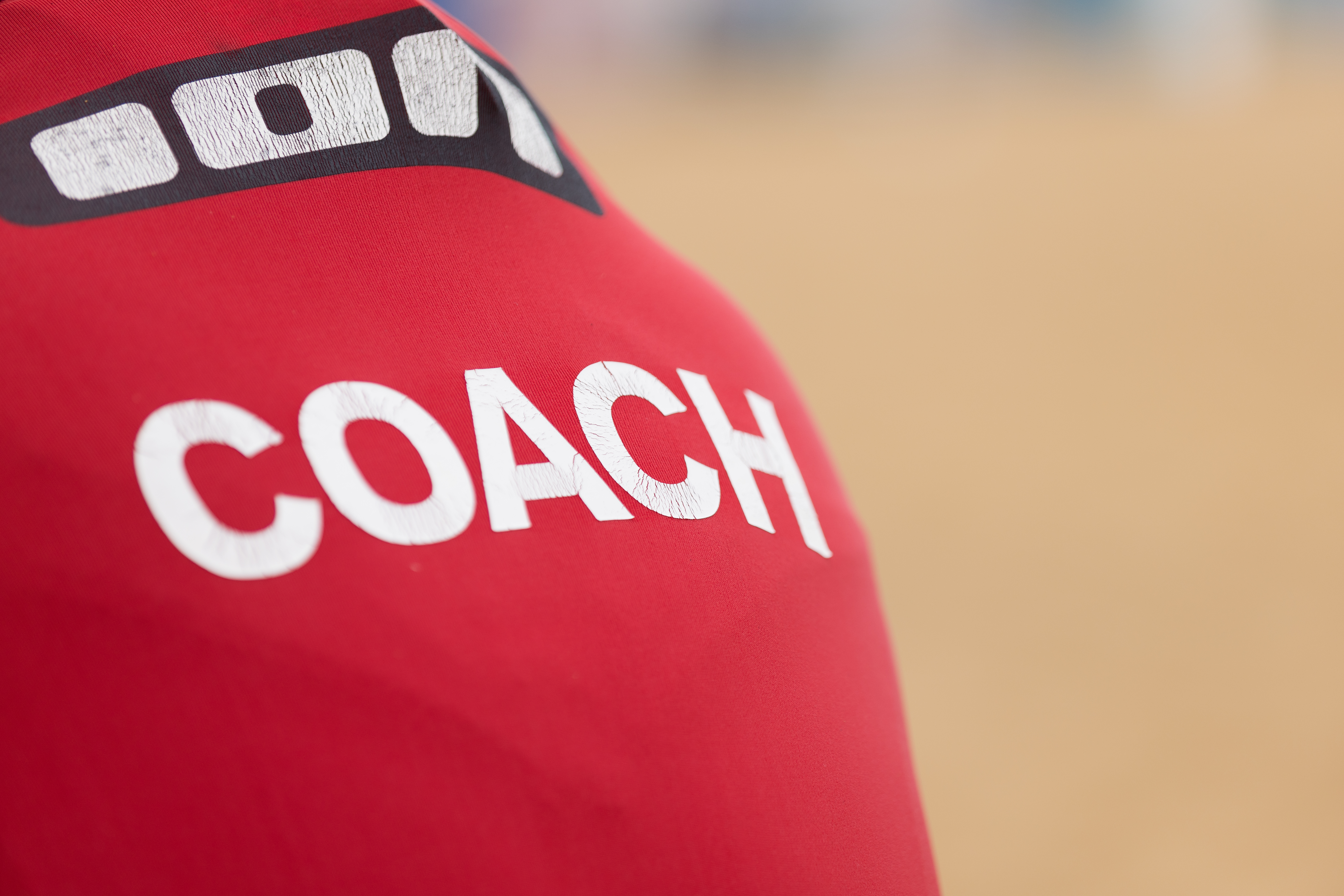
The school has been going a while, since 2005 in fact, and Shaggy, as his friends know him (“I was very skinny with long hair and a camper van when I was younger”) bought what was, in essence, a little garage used for storage and turned it into what is now a well known school and also a club.
After getting support from the Council and more and more people got to the know the School, Shaggy never looked back and the rest, as they say, is history.
There was, of course, a lot of hard work involved, but Andy and his wife, Gemma, built something that is not just a Surf School, but an important focal point for the community, especially when it comes to helping kids with disabilities.
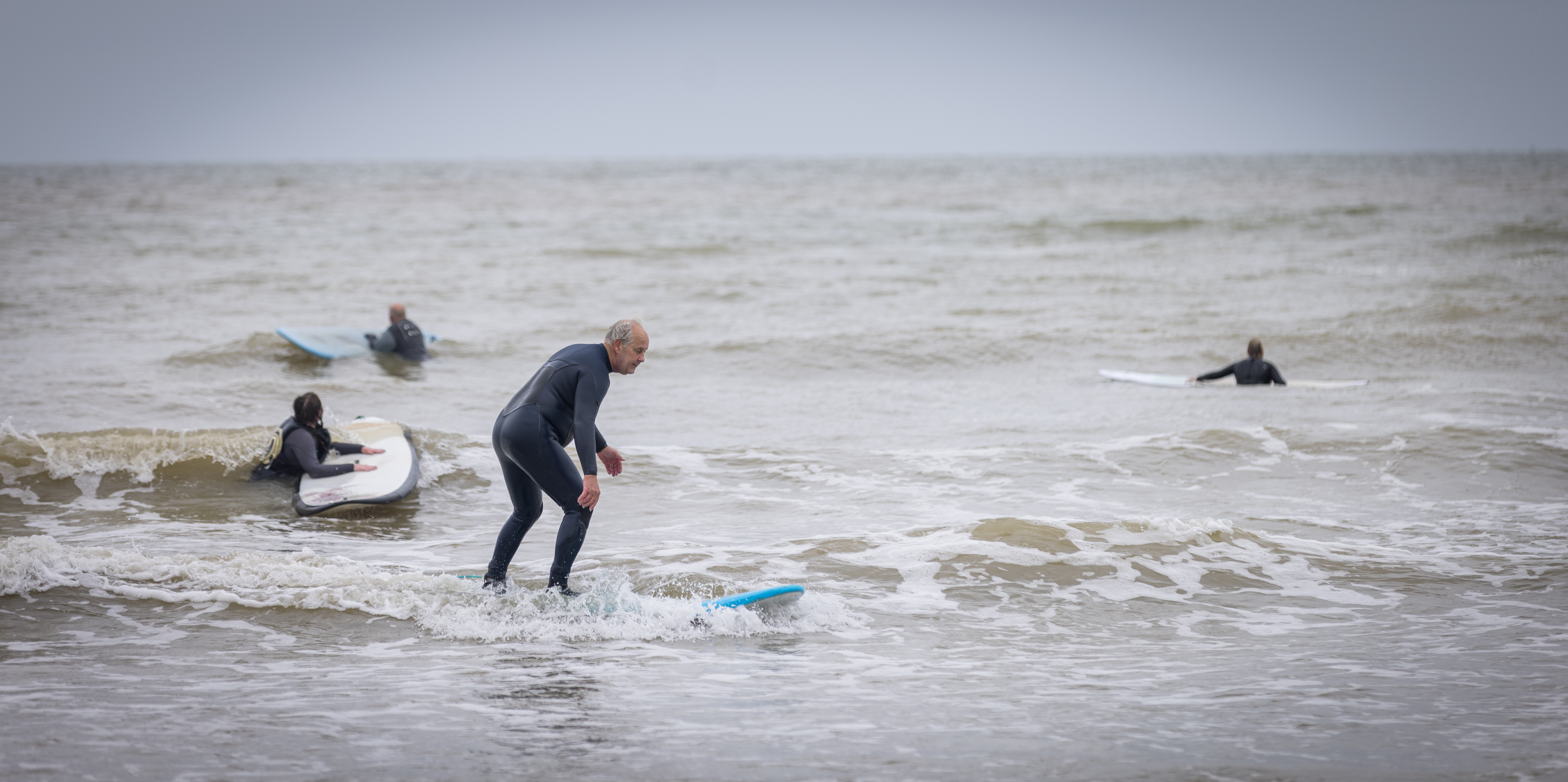
Being a “soul surfer” since the age of 10, Andy is absolutely passionate about what he does and what the School means to him and everyone that uses it. He told me that when he was younger only a few people surfed, nowadays one can get access to wet suits and boards easily and the whole experience is very affordable although Andy does recommend having a lesson first allowing one to acquire a sea safety knowledge which is essential. There are rip currents, winds dangers and general hazard to learn before one can go paddling out at sea.
A basic kit can include a surf board for about £100 and a wet suit for approximately £20, but Andy reminds me that there are rules to every sport and these are learnt during the lessons.
There are “snaking rules” and “dropping rules” to learn, which has all to do with paddling out and dropping in in front of people and knowing exactly when or not to do this. I tell Andy “a bit like driving then and knowing when it is one’s right of way or not”. Andy smiles and agrees.
A soul surfer and great family man, it is clear that surfing is a big passion for Andy, but of his own admission, he tells me that, Gemma supports him all the way, taking responsibilities for the two children, one of whom was born at 23 weeks premature and has become a very good surfer with determination and strength.
Being a proud dad and recognising the need for giving children with disabilities the space and support to surf, Andy has also begun a parallel journey in creating a GoFundme page to buy equipment to adapt surf boards so that, children that need to, can then sit in and go out on the board safely.
What makes Shaggy happy then? “It means bringing people together, sharing a passion, being welcoming to everyone, building something together, giving something out of one’s own time, putting it together and creating something new”.
There is no “average day” in the life of Andy Webb though, he tells me he has always something to do, “in my head I am a busy person, I suffer from dyslexia so I am a different type of thinker, I am training to be with the ambulance service, SECAMB, have been there 15 months, and when I qualify, I want to teach first aid which is another one of my passions”.
“Water itself is a therapy, catch a wave, in the coldness of that water, it cushions you like a big hug, you feel the power of the water, it is a force of nature. All the issues in your head disappear, and you feel at one, that’s just another level. That’s when it becomes an addition, a good one, though, because you immediately want to catch another wave! Being happy is important. Surfing makes me happy. Getting more people to become soul surfers makes me happy”.
1.Alex, tell me why “the piano”, how difficult (or not) was it to learn to play the instrument and how long did it take you to master it?
Actually it was my parents who chose piano for me. They are music lovers and also plays the piano so it was an obvious choice when it comes to my music education. To be honest I don’t find learning the piano easy at all. In my work I am fortunate to come into contact of a lot of amazing musicians who naturally possess huge musical talents that almost feels like “superpower” to me. Most of my musical skills, for example aural skills, I have to work very hard to acquire. I have been learning jazz for over 20 years and it is only until the last few years I feel more at ease on the piano.
2. You are a pianist AND a composer. Which is more challenging, in your opinion, and why?
I think they are equally challenging to me, each in their own unique ways. As a pianist the most challenging aspect, to me, is the ability to hold the attention of the audience for 90 minutes and keep the performance interesting. I think it is a life-long learning process. When it comes to writing music I always want to try out strange ideas that not too many people have done before (otherwise why bother?) and sometimes it took me ages to figure out how to make certain concepts work in performance. I also sometimes write music as a technical challenge for myself and I end up with music that takes me long time to master. So I end up spending very long time working on new compositions.
3. What type of genre were you first attracted to before you went into jazz?
I was trained as a classical pianist before I came into contact of jazz. Classical music was the main genre of music I listened to back in the days (still love and listen to them now!). It was the time before internet and I knew nothing about jazz so for a period of time I thought Gershwin’s music is jazz and listened to that a lot. I was also naturally attracted to music with beautiful grooves like funk and RnB music but back then I was totally clueless and think of them as “just commercial music”.
4. The decision to steer towards “jazz” was due to what in particular?
I have always been fascinated by jazz and improvised music, even back in the 90s growing up in Hong Kong when information about jazz was quite scarce. It was during my university years in London when I finally had the opportunity to learn about this music and I dived right in. Also I think the nature of this music (complete freedom on stage) appeals to me and is more suitable for my temperament. The steering towards jazz is just a very natural outcome.
5. How do you approach your composition?
I always start with a “feel” and trying to write music that convey it. A “feel” could be an emotional feeling like, for example, nostalgia or a physical dance movement. These two aspects are both very important to me when writing music. I will also explore musical ideas that I am currently working on and trying to utilise them in my compositions. These could be harmonic ideas or rhythmic ideas. I also find thinking about musical ideas away from the instrument a good idea because one is not limited by their technical limitations and the music will sound more natural.
6. Are you more a night or day person when it comes to working on your music?
That is a very interesting question. The answer is when I am working on my music I will be thinking about it constantly. So even during late at night when I cannot use my acoustic piano I will still be toying with musical ideas in my head. I used to go to bed quite late and wake up late but now I have a more “normal” routine.
7. Who or what is your main inspiration currently?
In the past few years I listened to quite a lot of Fred Hersch’s recording. I love his approach to solo and duo playing and am inspired to explore that aspect of music making. In the process I discovered that I totally love performing solo and duo. They can be very fulfilling and liberating experiences. I also listen to and learn quite a lot of music by Thelonious Monk recently and am completely fascinated by them, both the harmonic and rhythmic concepts. I always love music by Dave Holland Quintet and it has always been a source of inspiration to me. I also discovered that I love listening to electronic ambience music and lo-fi music even though I know nothing of these genres. Some of my new music were inspired by listening to these types of music.
8. You have been touring recently, how did that go?
I just completed a short China Tour and it went really well. I have been to various cities in Mainland China before but this time it is my first visit to Beijing and performing with musicians over there. It was really fascinating to learn about their music scenes and getting to know new musical friends.
9. What is the most important thing to you when you are touring? Do you have a routine?
I think sufficient rest and relaxation is very important to me. Sometimes the travelling can be very hectic and I would rather chill out and rest in the hotel room before the gig. I will get quite nervous on stage if I do not have enough sleep. Also eating healthily and regularly on the road is very important to me.
10. Are you working on anything in particular at the moment?
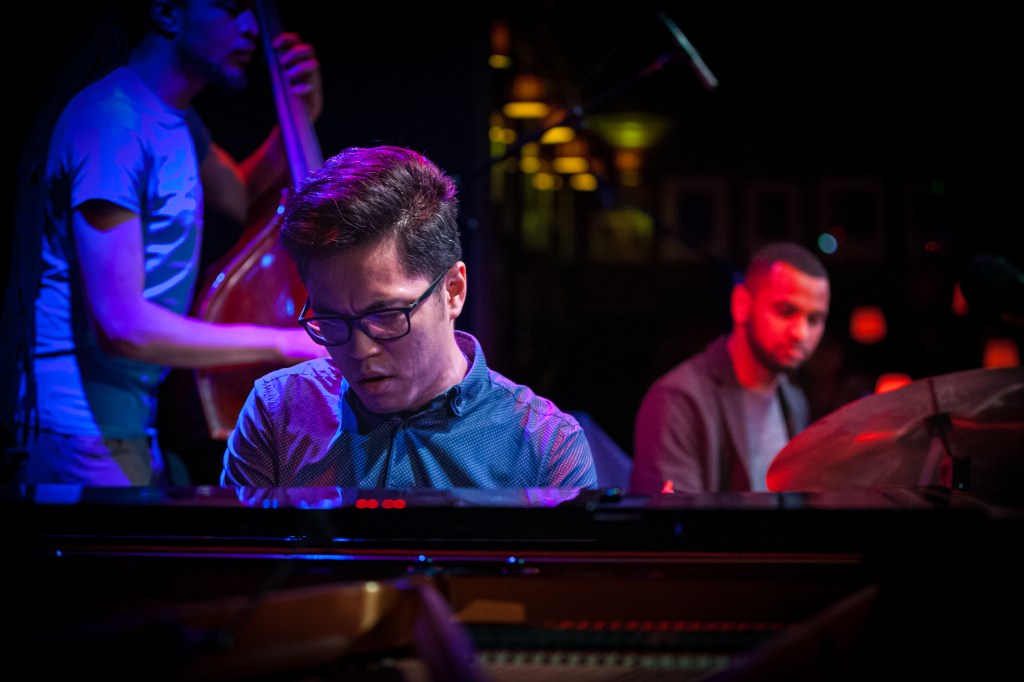
I am working on various projects at the moment, together with my ongoing exploration of solo piano playing. I have a short tour coming up in June with the very talented young guitarist Tommy Remon. I am also working on a piano + drums duo project with another very talented young drummer Michael Amosu.
11. Amongst all the venues you have played at, which is your favourite and why?
This is such a tough question because there are a lot of venues I played which are wonderful. The most important things to me are the piano and the acoustic of the place. Ronnie Scott’s is excellent in both aspects. There is a small venue in Hong Kong called Wantonmeen that I love performing in. The capacity is very small (30 people max) but the owner really takes great care in getting the best sound and performing experience for the artists. Another jazz club in Beijing called East Shore has one of the best acoustic that I ever experienced.
12. What kind of music are you listening to at the moment?
I listen to quite a bit of recordings by Fred Hersch, Thelonius Monk, Kieth Jarrett, Hank Jones and Duke Ellington at the moment. I also enjoy listening to music of the electronic and lo-fi genre, even though I have very limited knowledge in these areas.
13. Talking about reading, is there a book that means a lot to you?
There is a memoir by the famous classical pianist Georges Cziffra called Cannons and Flowers. Georges Cziffra was a legendary classical pianist and one of the very few old-school classical pianists that can improvise to a prodigious level. He had immense talent but also suffered huge misfortune in life. I read it many years ago while I was in music college studying classical performance. It means a lot to me because it was a very humbling experience reading about an extremely talented artist going through extreme hardships in life while always maintaining a hopeful and positive attitude by working hard. It makes me realise how fortunate most of us are nowadays (not only as a musician but just a person in general) and if even such a huge legend like Georges Cziffra did not complain about his unfortunate circumstances, we mortals do not have any excuse but to work hard and remain 100% dedicated.
14. Are you based in London nowadays? Do you plan to move elsewhere eventually?
I am based in London and had been for many many years. I currently do not have plan to move elsewhere but who knows what is going to happen in the future. My parents are in Hong Kong and as they are getting older every year I want to spend more time with them. Nothing is planned but nothing is ruled out!
15. What is London to you?
I think London to me is a place of inspirations. It is a unique place that I can meet people from all over the world with different musical influences and learn a lot from them. It allows one to explore and experiment with different concepts and ideas and has a vibrant creativity. It is also a great physical location as you can reach most of Europe, North America and Asia within 12 hours.
16. Tell me about “a day in the life of Alex Ho”: how do you relax?
There are some days in the week that I need to teach piano. But I always make sure I spend time in front of the piano on a daily basis no matter how long or how short it is. I spend a large proportion of my time listening to recordings. They could be music that I may want to learn or just in general listening to some random stuff. In the evening I may watch some movies (or listen to more music) to wind down.
17. Which is the most interesting place you have encountered during your travels?
I have to say Mainland China is one of the most interesting places I encountered. The place feels so vibrant and has a deep sense of culture. It is like an amalgamation of the past and the future. It has aspects that are deeply rooted in history while its people embrace new ideas and technologies with open arms. Because of its immense size, cities in one part of the country, for example Beijing, can have a totally different character than cities in other parts of the country such as Guangzhou. It is such an amazing experience exploring all these different places and their music scenes. They have lovely audiences in their jazz clubs and they really pay attention to what we do on stage. I definitely would love to visit again in the future.
18. If you could play another instrument, which one would it be and why?
I think it would definitely be the drums. I feel that the piano is actually very similar to the drums and they share some similar musical concepts. I love how the drums sings and dance in a track and can be backing and having a melodic line simultaneously. It is a very versatile instrument and nowadays with the use of electronics and triggering, drummers can make music on their own. A lot of the music that I am interested in are due to its interesting drum part.
19. Your album “Trio Soundscapism” released in 2016 was a great release, are you planning anew album soon?
Yes definitely! I am working on various solo and duo projects so watch this space!
20. And finally, what’s next for Alex Ho?
I think as a musician we can never be complacent and stop learning at any point in our lives. The more I learn the more I discover I need to learn. Also in the process of exploration I discovered aspects of myself that I never knew existed, for example my love of solo and duo performances. I feel very fortunate that I am in the position to continue this journey and who knows what I am going to discover about myself next?
This brand new online magazine was born from a conversation I had a while back with my partner.
I had become more interested to write or read narratives that were innovative and were offering new perspectives on various topics, like Social Media, for example. This is a tricky field because it is an everchanging “monster”.
I realized I wanted to start writing about themes and things that I love, that I feel strongly and passionate about, and approach these things with new glasses on, not rose-tinted ones, but more like wearing a fish-eye lense where the view is wide and encompassing.
I also wanted to be my own boss… so the name “A Different Press” came to my mind.
This magazine is about Style, Photography, Art, Music, but most of all, writing per se’, something that is slowly fading in my opinion.
I will look at the diverse world that is Travel, pointing out those pit-stops that are de-rigueur for the curious traveller, but there will also be plenty to read and discuss on jazz, for example, which is a music I have learnt to appreciate and love and have become addicted to.
I want to give space for a narrative to those with a real thirst for the unknown and want to learn more, always.
The magazine will eventually be open to contributors from both the writing and the visual world.


 A Different Press